Introduction
For undergraduate students exploring careers in anesthesia, two advanced practice professions exist that do not require medical school and residency: Certified Registered Nurse Anesthetists (CRNAs) and Anesthesiologist Assistants (AAs/CAAs). Both careers are in high demand, deliver safe and effective anesthesia care, and offer competitive compensation. However, the educational pathways, levels of autonomy, and geographic practice opportunities differ in ways that matter significantly to a prospective clinician. This article is written as a high-level overview for students considering anesthesia as a career.
CRNA
Certified Registered Nurse Anesthetists (CRNAs) are advanced practice registered nurses who administer anesthesia in every type of healthcare setting. To start this path, you first need a Bachelor of Science in Nursing (BSN) and your RN license. You must then obtain at least 1–2 years of critical care nursing experience working in an Intensive Care Unit (ICU) before you can be accepted to a program.
As of 2022, all new graduates must now complete a doctoral degree (DNP or DNAP). These intensive three-year programs combine doctoral-level science and anesthesia classes with thousands of hours of hands-on clinical training. Once you graduate, you take the NBCRNA National Certification Exam and keep licenses current through ongoing education and assessments.
AA/CAA
Anesthesiologist Assistants (AAs) - formally called Certified Anesthesiologist Assistants (CAAs) - take a completely different track. You generally start with a bachelor’s degree, including prerequisites like calculus, physics, and organic chemistry. Students then enter a master’s-level CAA program, which usually takes 24–28 months. This program gives you both classroom instruction (didactic) and dedicated clinical anesthesia training. After graduating, CAAs certify through the NCCAA and maintain their credentials through continuous education and exams. For students with a strong science background who prefer a direct line into anesthesia without prior RN or ICU experience, the AA/CAA route is often the faster option.
Side-by-Side Comparison
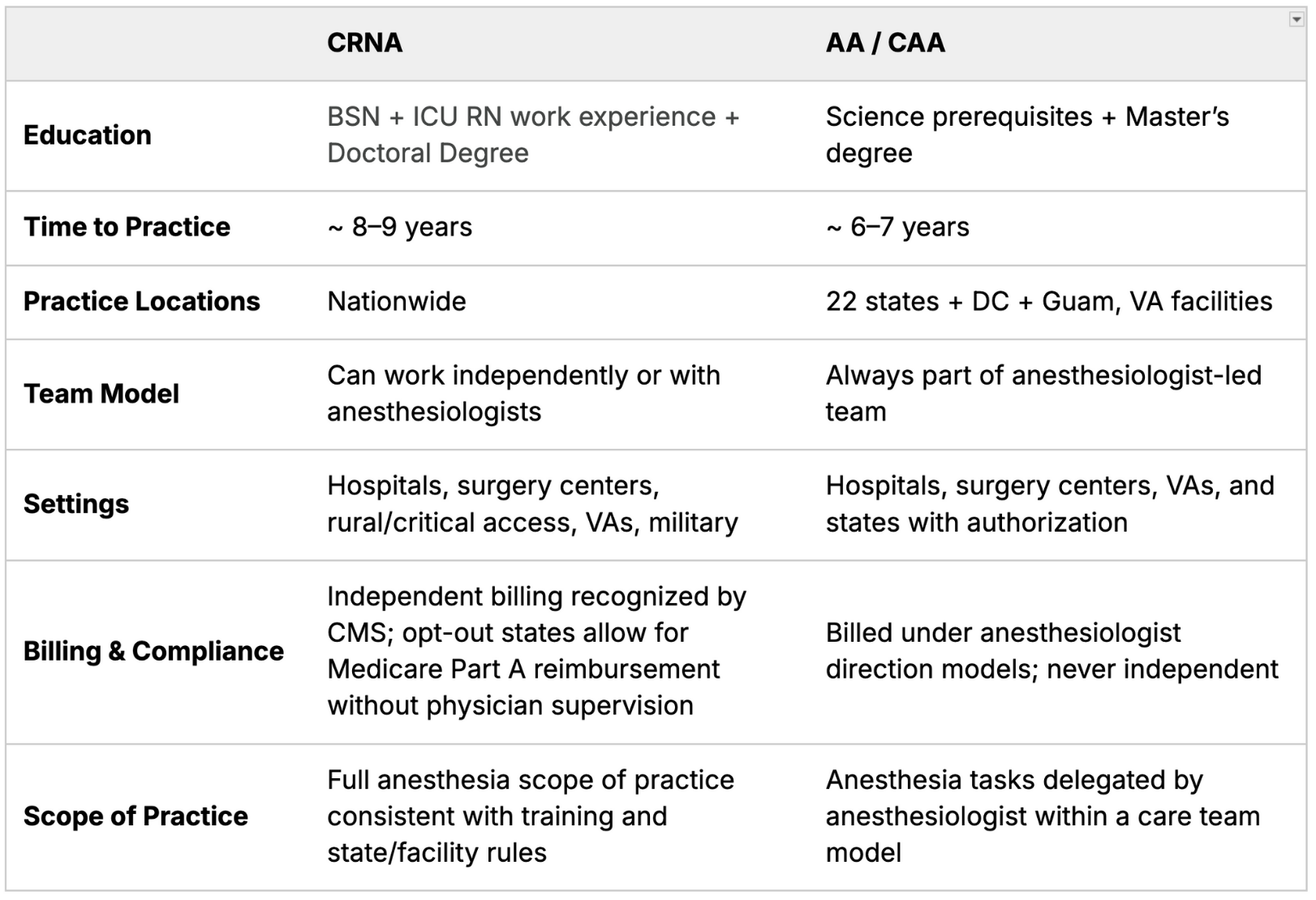
Here’s how the two professions compare:
Autonomy, Team Models, and Geography
The fundamental distinction between these two roles hinges on practice autonomy. Certified Registered Nurse Anesthetists (CRNAs) are advanced practice nurses licensed to practice in all 50 states. Crucially, in over 20 states, CRNAs have full independent practice authority, meaning they can manage anesthesia cases autonomously, especially in rural and critical access facilities. By contrast, Anesthesiologist Assistants (AAs) are legally required to work under the direct, physical supervision of a physician anesthesiologist in all settings where they practice. This dependency dictates the AA's location flexibility and leadership potential, whereas the CRNA role offers a clear path toward independent practice in many parts of the country.
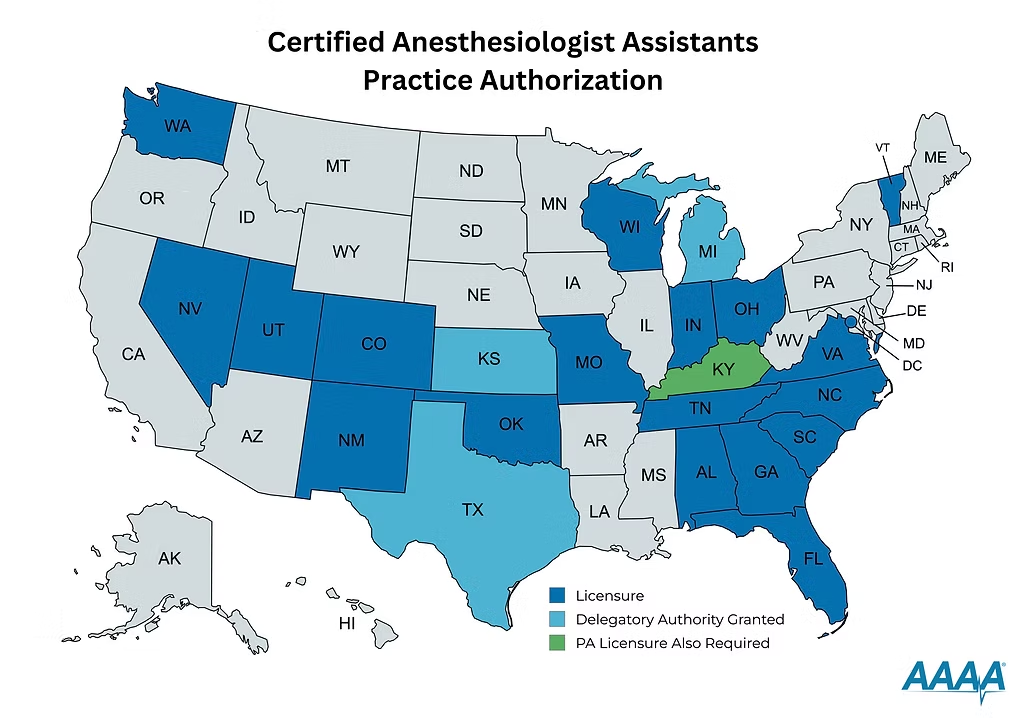
Geography adds another layer of difference. CRNAs can practice nationwide while AAs are currently only recognized in 24 jurisdictions (22 states, plus DC and Guam). For students, this means the CRNA path generally offers broader geographic mobility, while the AA path can be an appropriate option if you're comfortable with geographic and practice limitations or know that you want to remain in a state that already authorizes AAs.
Workforce Size and Projected Growth
While both CRNAs and CAAs represent the non-physician anesthesia workforce, CRNAs are a much larger segment, with an estimated 62,000 certified professionals nationwide. According to the Bureau of Labor Statistics, CRNA employment is projected to grow by 9% annually between 2024 and 2034, driven by rising surgical demand, outpatient procedure growth, and workforce retirements. The CRNA education pipeline is robust, with 142 accredited programs and roughly 4,000 new students enrolling each year, ensuring a steady influx of new clinicians into the field.
In contrast, CAAs form a smaller but rapidly expanding subset of the anesthesia care team, with approximately 4,000 certified practitioners practicing across 22 states, the District of Columbia, and Guam. Exact statistics on projected employment growth for CAAs are less well established, but as with CRNAs, the profession is clearly poised for continued expansion, driven by an increasing need for skilled anesthesia providers as the population ages and more providers retire. The CAA training pipeline remains limited but is scaling, with around 20 accredited programs collectively graduating more than 300 new CAAs per year. Each new state that licenses CAAs expands employment opportunities and incentivizes program development, with several programs already seeking accreditation or currently under development.
Together, these trends illustrate how both CRNAs and CAAs are critical to addressing the nation’s anesthesia workforce needs—CRNAs through a broad, established network and CAAs through a smaller but accelerating footprint that’s gaining momentum as more states open pathways for practice.
Job Market Outlook and Compensation Trends
Both professions are currently operating in a market of extraordinary and persistent demand. The U.S. continues to face a significant, long-term shortage of anesthesia providers, which has created strong job opportunities for both CRNAs and AAs. At Marit, we hear consistently from employers that filling anesthesia roles is one of their most significant staffing challenges. Graduates in either pathway can be confident that their skills will be in demand from day one.

Choosing Between CRNA and AA
Ultimately, students weighing these two paths must reflect on their own backgrounds, lifestyle goals, and ambitions. The choice often boils down to a few core trade-offs: if a potential student already has a BSN with critical care experience, or if they prioritize the highest level of practice autonomy and nationwide mobility, the CRNA pathway is the clear choice. Conversely, for science majors seeking the most direct and expeditious route into anesthesia and who accept the downstream geographic and team-based practice limitations, the AA/CAA role offers a faster entry point. Regardless of the path chosen, both CRNAs and CAAs enter a field where their specialized skills are immediately valued and consistently in demand.
Despite these differences, both professions are highly respected, stable, and rewarding. CRNAs and AAs may take different paths to the operating room, but both careers lead to impactful work in one of healthcare’s most in-demand fields.

Help us bring transparency to medicine